

Table of Contents
Managing freelance taxes in France requires understanding URSSAF, VAT, and income tax rules.
Introduction: Why Freelance Taxes Confuse So Many Expats in France
Freelancing has become one of the most common ways for expats to earn money in France. From graphic designers and online consultants to delivery drivers and ride-share drivers, thousands of people now work independently instead of holding traditional employment contracts.
In cities like Paris, it’s very common to see expats earning income through digital freelancing, consulting, or gig-economy platforms. Some people work remotely for international clients, while others drive for ride-sharing platforms or run small service businesses.
However, while earning income independently can be flexible and rewarding, the tax system for freelancers in France is very different from the salaried system.
Employees in France usually don’t worry about taxes because their employer handles most administrative obligations. Taxes and social contributions are deducted automatically from their salary.
Freelancers, on the other hand, must manage several responsibilities themselves:
- declaring income to the French tax administration
- paying social contributions
- understanding VAT (TVA) obligations
- paying local business taxes
- filing annual tax returns
For many expats, this system feels complicated at first.
In fact, one of the most common situations I have personally seen is with people who start earning money through ride-sharing platforms. Someone opens an account, starts driving, and receives payments regularly. Everything seems simple at the beginning.
But months later, they receive letters about social contributions, tax declarations, or unpaid charges, sometimes with penalties.
This happens because many people start earning before understanding how the freelance tax system works in France.
This guide explains the system step by step in clear language so that expats can understand:
- how freelance taxation works in France
- what taxes and contributions apply
- how to avoid penalties and mistakes
- what tax regime is best depending on your activity
Throughout this guide, we will reference official sources such as the French tax authority Direction générale des Finances publiques and the social contribution agency URSSAF.
By the end, you will have a clear understanding of how freelancers in France manage their taxes — and how to stay compliant without unnecessary stress.
1. Understanding Freelance Taxes in France
Before discussing freelance taxes, it’s important to understand how independent work is classified in France.
Unlike some countries where “freelancer” is just a general term, France uses specific legal structures to define self-employment.
Most independent workers fall into one of these categories:
- micro-entrepreneur (auto-entrepreneur)
- entrepreneur individuel (individual business owner)
- company structures such as EURL or SASU
For beginners and small independent activities, the most common structure is the micro-entrepreneur regime.
This simplified system allows individuals to start a business quickly with minimal administrative burden. It is often used by freelancers, consultants, delivery drivers, and small service providers.
Under the micro-entrepreneur system:
- taxes and social contributions are calculated based on turnover rather than profit
- accounting requirements are simplified
- administrative obligations are lighter than traditional businesses
Because of its simplicity, this regime has become extremely popular among freelancers and gig-economy workers.
According to data from INSEE, millions of micro-entrepreneurs are now registered in France, and the number continues to grow every year.
Where Does Uber or Ride-Share Income Fit?
Many expats ask a very practical question:
If someone earns money by driving for Uber or similar platforms, are they considered freelancers?
The answer is yes — but legally they are usually registered as micro-entrepreneurs.
Drivers working with platforms like Uber generally operate as independent self-employed workers, not employees.
This means they must:
- register their activity
- declare their income
- pay social contributions
- report their taxes
In practice, most ride-share drivers register as micro-entrepreneurs under transport services.
From personal experience and conversations with people in the expat community, many drivers start earning money quickly but do not fully understand the tax side of the system.
For example:
Someone opens a ride-share account, begins driving regularly, and receives monthly payments. Everything feels straightforward.
But after several months, they may receive notifications from the social contribution agency asking them to declare turnover and pay contributions.
If they ignore these obligations or fail to register properly, they can face late declarations, penalties, or unexpected tax bills.
This is why understanding the structure of freelance taxation in France is so important before starting an independent activity.
2. Core Freelance Taxes in France Explained
Once you are registered as an independent worker, several types of taxes and contributions may apply.
These obligations vary depending on your activity and tax regime, but most freelancers in France deal with four main categories:
1. Income Tax (Impôt sur le Revenu)
Freelancers must declare their income as part of the French personal income tax system.
The official tax administration responsible for collecting and managing income tax is Direction générale des Finances publiques.
Income tax is calculated using a progressive scale, meaning the tax rate increases as income rises.
Freelancers typically report their income during the annual tax declaration process through the government portal.
2. Social Contributions
In addition to income tax, freelancers must contribute to the French social security system.
These payments help fund:
- healthcare coverage
- retirement pensions
- family benefits
- professional training programs
Social contributions for freelancers are collected by URSSAF.
Unlike salaried employees whose contributions are deducted automatically, freelancers must declare their turnover and pay these contributions themselves.
3. Local Business Tax (CFE)
Another obligation for most freelancers is the Cotisation Foncière des Entreprises (CFE).
This is a local business tax collected by municipalities where the business is registered.
Even small independent activities can be subject to this tax once certain revenue thresholds are reached.
Detailed guidance is provided by the official government portal Service-Public.fr.
4. VAT (TVA)
Depending on the level of revenue and the nature of the activity, freelancers may also need to charge value-added tax, known in France as TVA.
VAT rules can appear complicated at first, especially for freelancers who work with international clients.
The system is regulated by the French tax administration and explained on the official portal Impots.gouv.fr.
3. Income Tax for Freelancers in France
Once you start earning as a freelancer in France, your profits are not taxed separately like a corporate tax. Instead, most freelancers pay personal income tax, which is integrated into the national tax system.
This tax is known as Impôt sur le Revenu, and it is administered by the French tax authority Direction générale des Finances publiques.
The important thing to understand is that freelance income is added to your household income and taxed according to France’s progressive tax scale.
For expats who come from countries with flat tax systems, this progressive structure can initially be confusing.
How the Progressive Tax System Works
France uses a progressive tax model, which means the more you earn, the higher the marginal tax rate becomes.
However, this does not mean your entire income is taxed at the highest rate. Instead, different portions of your income fall into different brackets.
For the recent tax years (2025 and the expected 2026), French residents filing taxes through Impots.gouv.fr fall under a progressive income tax system:
- Income up to €11,497 is taxed at 0%.
- Income between €11,498 and €29,315 is taxed at 11%.
- Income between €29,316 and €83,823 is taxed at 30%.
- Income between €83,824 and €180,294 is taxed at 41%.
- Income above €180,295 is taxed at 45%.
Because the system is progressive, many freelancers often pay a lower effective tax rate than they might initially expect.
Freelance Income and Household Taxation
Another unique aspect of the French system is that taxes are calculated at the household level, not strictly at the individual level.
France uses something called the family quotient system, which divides taxable income by the number of household “shares”.
For example:
- a single person typically has 1 share
- a married couple usually has 2 shares
- children can add additional shares
This system can significantly reduce the tax burden for families compared to single taxpayers.
The concept is explained in detail by the official tax authority Direction générale des Finances publiques.
For expats with spouses or children living in France, this system often results in lower overall taxation than expected.
How Freelancers Declare Their Income
Unlike employees whose taxes are mostly handled automatically through payroll withholding, freelancers must declare their income themselves.
Most independent workers submit their income using an additional tax form called 2042-C-PRO, which is attached to the standard annual tax declaration.
The declaration process typically involves:
- Logging into the official tax portal
- Declaring your annual turnover or professional income
- Confirming deductions or applicable allowances
- Submitting the declaration electronically
☞ This process is done online through the French government’s tax portal Impots.gouv.fr.
Example: Freelance Income Tax Calculation
To better understand how the system works, consider a simple example.
Imagine a freelance graphic designer living in Paris who earns €50,000 in annual turnover.
Depending on the tax regime, the taxable portion of that income may be reduced through fixed allowances or deductible expenses.
For example, under the micro-entrepreneur regime, the government automatically applies a flat expense deduction before calculating taxable income.
This means the freelancer does not pay income tax on the full €50,000.
Instead, only a portion of that income becomes taxable.
This simplified system is one of the main reasons why many freelancers initially choose the micro-entrepreneur regime.
Why Many Expats Underestimate Their Tax Obligations
One of the biggest mistakes new freelancers make is assuming that income tax is the only tax they must pay.
In reality, freelance taxation in France usually involves two major layers:
- Income tax
- Social contributions
These social contributions fund public services such as healthcare, pensions, and family benefits, and they can represent a significant percentage of freelance income.
They are managed by the French social contribution agency URSSAF.
Because these payments are separate from income tax, many new freelancers underestimate their total obligations during their first year.
This is particularly common among people earning through online platforms or gig-economy work who may not initially realize they are considered self-employed under French law.
4. URSSAF and Freelance Taxes in France
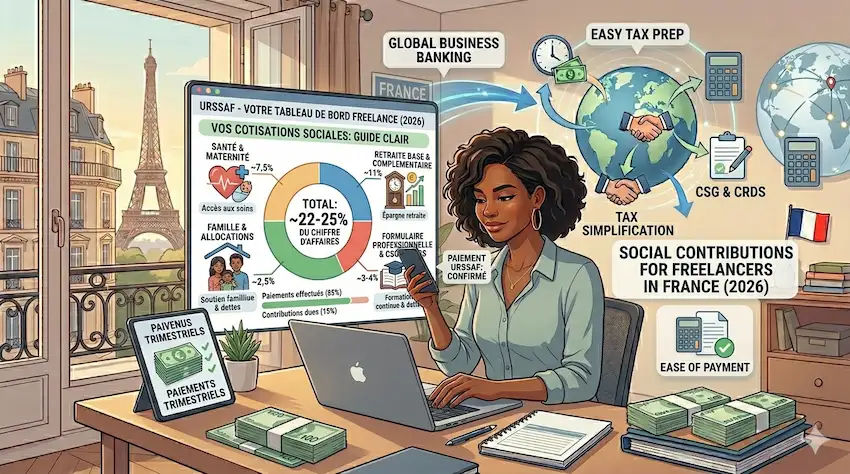
For many freelancers, the biggest surprise is not income tax — it is social contributions.
In fact, these payments are often larger than the income tax itself, especially during the early years of a freelance activity.
Social contributions are collected by the national agency responsible for funding the French social security system: URSSAF.
These contributions finance several key parts of the French welfare system, including:
- public healthcare coverage
- retirement pensions
- family allowances
- maternity and parental benefits
- professional training rights
Because freelancers are considered independent workers, they must pay these contributions themselves rather than having them automatically deducted from a salary.
Why URSSAF Exists
France operates a universal social protection system. Employees contribute to this system through payroll deductions, but freelancers contribute through URSSAF declarations based on their income or turnover.
According to the official explanations provided by URSSAF, self-employed workers must declare their activity and regularly report their revenue.
Once registered, freelancers typically declare their turnover:
- monthly, or
- quarterly
These declarations allow URSSAF to calculate the social contributions owed.
Contribution Rates for Micro-Entrepreneurs
For freelancers operating under the micro-entrepreneur regime, social contributions are calculated as a fixed percentage of turnover.
This simplified structure is one of the reasons why many expats choose the micro-entrepreneur system when starting a business.
Approximate contribution rates include:
- Commercial sales about 12.3%
- Service activities about 21.2%
- Liberal professions around 22–24%
These percentages apply to turnover, not profit.
This means that even if a freelancer has expenses, contributions are still calculated based on the total amount invoiced.
The official rates and explanations are available through the government information portal Service-Public.fr.
Example: Freelance Social Contribution Calculation
Consider a freelancer providing digital marketing services and earning €40,000 in annual turnover.
Under the micro-entrepreneur regime for service activities, the contribution rate is roughly around 21–22%.
This means their estimated annual social contributions would be approximately:
€40,000 × 22% ≈ €8,800
This payment contributes to:
- health insurance coverage
- pension rights
- family benefits
Although the percentage may seem high compared to some countries, freelancers in France gain access to the national healthcare system administered through Assurance Maladie.
Reduced Contributions for New Freelancers
Some freelancers may qualify for temporary reductions in social contributions during the first year of activity.
This program is known as ACRE (Aide à la Création ou à la Reprise d’Entreprise).
It provides partial reductions in social contributions for eligible entrepreneurs who start a new business.
Official details about this program are available through Service-Public.fr.
However, eligibility rules can change periodically, so it is always important to verify the latest requirements before applying.
Common Mistakes in Freelance Taxes in France
From conversations within expat communities, several mistakes appear repeatedly when people first start freelancing in France.
Starting to Earn Before Registering
Some people begin working on platforms or freelancing online before registering their business.
Even if the income seems small at first, French authorities still expect official registration and declarations.
Ignoring URSSAF Notifications
Once a freelancer registers, URSSAF sends regular notifications requesting turnover declarations.
If these declarations are ignored, the agency may estimate income and issue penalties or additional charges.
Confusing Turnover with Profit
Under the micro-entrepreneur system, contributions are calculated from turnover, not net profit.
New freelancers sometimes underestimate their obligations because they expect expenses to reduce the amount owed.
Why Understanding URSSAF Early Matters
Understanding URSSAF obligations early can prevent one of the most stressful situations freelancers face: receiving unexpected contribution bills months after starting their activity.
For expats who are unfamiliar with the French system, learning how social contributions work is one of the most important steps toward running a sustainable freelance business.
In the next section, we will explore another key part of freelance taxation in France: the different tax regimes and how to choose the right one for your activity.
This includes the widely used micro-entrepreneur regime as well as more advanced systems for freelancers with higher income or significant business expenses.
5. Choosing the Right Tax Regime for Freelancers in France
One of the most important decisions when starting a freelance activity is choosing the appropriate tax regime.
The structure you choose determines:
- how your income is taxed
- how social contributions are calculated
- what accounting obligations you must follow
- whether you can deduct business expenses
For most expats and beginners, the choice usually comes down to two main systems:
- Micro-Entrepreneur (Micro-Enterprise)
- Régime Réel (Real Tax Regime)
Each option has advantages depending on your income level, business expenses, and long-term plans.
Official explanations of these regimes are provided by the French government through Service-Public.fr.
The Micro-Entrepreneur Regime
The micro-entrepreneur regime (formerly called auto-entrepreneur) is by far the most popular structure for freelancers starting their activity in France.
It was created to simplify small business creation and reduce administrative barriers for independent workers.
Under this regime:
- taxes and social contributions are calculated from turnover
- accounting requirements are simplified
- administrative procedures are relatively light
Registration is usually done online through the French business registration system managed by INPI.
Many types of freelancers use this system, including:
- designers and developers
- consultants
- translators
- delivery drivers
- ride-share drivers working with platforms like Uber
Because it is simple and fast to set up, this regime is often the first step into freelancing for expats living in France.
Advantages of the Micro-Entrepreneur System
There are several reasons why the micro-entrepreneur regime is so widely used.
Simple Administration
Freelancers do not need full accounting systems or detailed balance sheets.
Instead, they only need to:
- track their turnover
- issue compliant invoices
- declare revenue to URSSAF.
Predictable Contribution Rates
Since contributions are calculated as a fixed percentage of turnover, freelancers can estimate their obligations easily.
This simplicity is especially useful during the first year of business when income may be unstable.
Faster Business Setup
Many freelancers can register their activity online in a relatively short time, which makes it attractive for expats who want to start earning quickly.
Limitations of the Micro-Entrepreneur System
Despite its simplicity, this regime also has some important limitations.
The most important one is that expenses cannot be deducted directly.
Instead, the government applies a standard allowance before calculating taxable income.
This means freelancers with large business expenses may sometimes pay more tax than they would under another regime.
Another limitation involves turnover ceilings, which determine whether a freelancer can continue using the micro-entrepreneur system.
6. Micro-Entrepreneur Turnover Limits
To remain in the micro-entrepreneur regime, freelancers must stay below certain annual turnover thresholds.
These limits are updated periodically by the French government and published through official sources such as Service-Public.fr.
The approximate thresholds currently used are:
- Services & professional activities about €77,700
- Commercial sales about €188,700
These limits apply to gross revenue before expenses.
If a freelancer exceeds these limits for two consecutive years, they will usually need to transition to a different tax regime.
What Happens if You Exceed the Limits?
When a freelancer exceeds the micro-entrepreneur turnover thresholds, they may automatically move to a more traditional tax system.
This usually means switching to the régime réel, which requires:
- full accounting records
- profit-based taxation
- more detailed administrative reporting
Although this system is more complex, it can actually become more advantageous for freelancers with higher income or significant expenses.
When the Régime Réel May Be Better
The régime réel allows freelancers to deduct legitimate business expenses before calculating taxable profit.
These deductions can include:
- office rent or coworking space
- professional software subscriptions
- equipment such as computers or cameras
- accountant or legal service fees
Because expenses are deductible, freelancers with high operational costs sometimes pay less overall tax under the régime réel despite the additional administrative complexity.
7. VAT (TVA) Rules for Freelancers in France
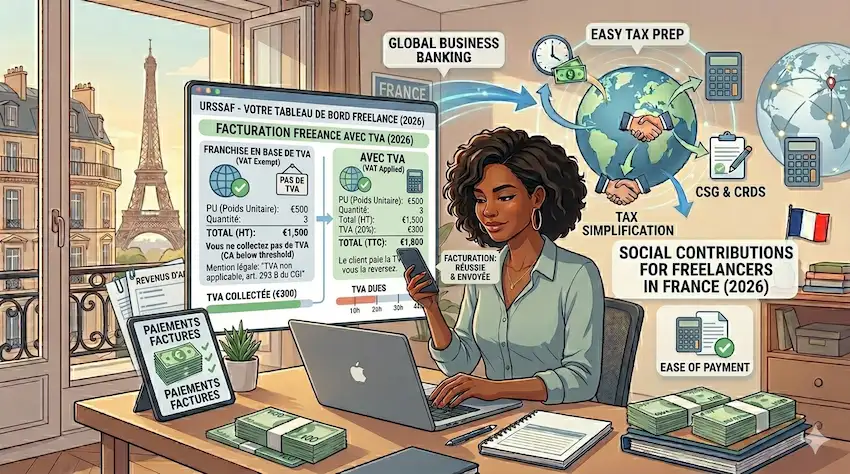
Another important part of freelancing in France is understanding VAT, which is known locally as TVA (Taxe sur la Valeur Ajoutée).
VAT is a consumption tax applied to most goods and services in France and across the European Union. Businesses typically collect this tax from their customers and then transfer it to the tax administration.
The VAT system in France is managed by the national tax authority Direction générale des Finances publiques, and official guidance is available through the government portal Impots.gouv.fr.
For freelancers, the key question is simple:
Do you need to charge VAT to your clients?
The answer depends mainly on your annual turnover and tax regime.
The VAT Exemption for Small Freelancers
Many freelancers in France benefit from a simplified rule called “franchise en base de TVA.”
This system allows small businesses to operate without charging VAT until they exceed certain turnover thresholds.
Approximate thresholds currently applied are:
- Service activities about €37,500
- Commercial sales about €85,000
As long as your turnover remains below these limits, you generally do not need to charge VAT on your invoices.
Instead, invoices must include a statement indicating that VAT is not applicable under the exemption rule.
This rule greatly simplifies accounting for many freelancers during the early stages of their business.
When Freelancers Must Register for VAT
Once a freelancer exceeds the VAT threshold, they are usually required to:
- register for VAT
- add VAT to invoices
- submit VAT declarations to the tax administration
The standard VAT rate in France is currently 20%, although reduced rates apply to certain industries.
After registration, freelancers collect VAT from their clients and periodically report it to the tax administration.
The official explanations for VAT obligations can be found through Impots.gouv.fr.
VAT and International Clients
For freelancers working online, VAT rules can become slightly more complex.
The treatment depends on whether the client is:
- located in France
- located in another EU country
- located outside the European Union
For example:
- Services provided to EU businesses may follow reverse-charge VAT rules.
- Services provided to clients outside the EU are often exempt from French VAT.
Because these rules depend on the nature of the service and the client’s tax status, freelancers working internationally should always verify the correct invoicing method before issuing invoices.
8. Invoicing Requirements for Freelancers in France
Issuing compliant invoices is an essential responsibility for freelancers in France.
French regulations require invoices to include several mandatory pieces of information to ensure transparency and proper tax reporting.
Official invoicing guidelines are published by Service-Public.fr.
A typical freelance invoice must include:
- the freelancer’s name and address
- the client’s name and address
- the freelancer’s SIRET number
- a unique invoice number
- the date of issue
- the service description
- the total amount charged
- VAT information (if applicable)
If the freelancer benefits from the VAT exemption system, the invoice usually includes a note stating that VAT is not applicable under the “franchise en base de TVA.”
Maintaining accurate invoices is important because they serve as the primary documentation for tax declarations and accounting records.
Why Proper Invoicing Matters
Many freelancers underestimate how important proper invoicing is until they encounter administrative problems.
Accurate invoices help ensure:
- correct tax declarations
- proof of income if requested by authorities
- transparency with clients
- easier accounting and bookkeeping
In the event of a tax audit or administrative review, invoices are one of the first documents authorities may request.
For this reason, many freelancers use accounting tools or invoicing software to keep organized records of all transactions.
9. Local Business Tax (CFE)
Many freelancers are surprised to learn that there is also a local business tax in addition to income tax and social contributions.
This tax is called Cotisation Foncière des Entreprises (CFE).
CFE is part of the local business taxation system known as Contribution Économique Territoriale, and it is collected by the municipality where the business is registered.
Official explanations and rules are published by the French tax authority Direction générale des Finances publiques and the government information portal Service-Public.fr.
When Freelancers Must Pay CFE
Most freelancers become liable for CFE once their activity is established.
However, there are some important rules:
- The first year of business is generally exempt from CFE.
- Freelancers whose annual turnover is below €5,000 are usually exempt.
- From the second year onward, most freelancers must pay the tax.
Because CFE is a local tax, the amount varies depending on the city where the business is registered.
For example, the amount can differ significantly between smaller towns and large cities such as Paris.
Typical CFE Amounts
Although the exact amount varies by municipality, freelancers typically pay somewhere within the following range:
- Small freelance activity €200 – €400
- Medium activity €400 – €800
- Larger independent business €800 – €2,000+
The exact amount depends on local rates and the value assigned to the business premises used for the activity.
Even freelancers working from home may still be subject to CFE.
When CFE Must Be Paid
CFE is usually paid once per year, with payment typically due in December.
Freelancers receive notifications through their account on the official tax portal Impots.gouv.fr.
Because the tax is annual, many freelancers prefer to set aside a small amount of money each month so the payment does not feel sudden at the end of the year.
10. Example: Freelance Income and Taxes in France
Understanding the theory is useful, but real examples often make the system clearer.
Below are simplified examples showing how taxes and contributions might look for freelancers earning different levels of income.
These examples assume a freelancer operating under the micro-entrepreneur regime for service activities.
Example 1: Freelancer Earning €30,000 per Year
Annual turnover: €30,000
Estimated obligations:
- Social contributions (~22%) → about €6,600
- Income tax → depends on personal situation
- CFE → about €200–€400
Because the income is relatively moderate, the freelancer remains within the micro-entrepreneur regime and may also remain below the VAT threshold.
Example 2: Freelancer Earning €60,000 per Year
Annual turnover: €60,000
Estimated obligations:
- Social contributions (~22%) → about €13,200
- Income tax → calculated after allowances
- CFE → around €300–€800
At this level, freelancers often start planning their finances more carefully to ensure enough money is reserved for taxes and contributions.
Example 3: Freelancer Earning €90,000 per Year
Annual turnover: €90,000
At this level, several important changes may occur:
- the freelancer may exceed the micro-entrepreneur turnover threshold
- VAT registration may become necessary
- accounting obligations may increase
In such cases, some freelancers transition to the régime réel, which allows expenses to be deducted from taxable profit.
Why Estimating Taxes in Advance Is Important
One of the most common mistakes freelancers make is spending all their income without reserving money for taxes and contributions.
A simple strategy many independent workers follow is to save around 25–30% of income in a separate account for tax obligations.
11. Accounting and Record-Keeping Tips for Freelancers
Good financial organization is essential for running a sustainable freelance business in France.
Even though the micro-entrepreneur regime simplifies accounting obligations, freelancers are still required to maintain accurate records of their financial activity.
Official administrative guidance for independent workers is provided through Service-Public.fr.
At a minimum, freelancers should maintain records of:
- all invoices issued to clients
- turnover declarations submitted to URSSAF
- business-related expenses (if applicable)
- tax declarations submitted through Impots.gouv.fr
Keeping organized financial records helps ensure compliance with tax regulations and simplifies annual tax declarations.
Separate Personal and Business Finances
One of the simplest ways to stay organized is to separate business finances from personal spending.
In France, freelancers whose annual turnover exceeds €10,000 for two consecutive years are legally required to maintain a separate bank account for business transactions.
This requirement is explained by the official government portal Service-Public.fr.
Even when it is not legally required, using a separate account can make bookkeeping significantly easier.
Useful Tools for Freelancers
Many freelancers use digital tools to simplify their accounting and invoicing processes.
These tools can help with:
- creating compliant invoices
- tracking income and expenses
- calculating estimated taxes
- preparing financial reports
Some freelancers also choose to work with accountants, especially once their activity grows or they transition to the régime réel.
12. Important Tax Deadlines for Freelancers
Understanding tax deadlines is essential to avoid penalties or late fees.
Freelancers typically deal with several recurring obligations throughout the year.
URSSAF Declarations
Freelancers must regularly declare their turnover to URSSAF.
Declarations are usually made:
- monthly, or
- quarterly
After the declaration is submitted, URSSAF calculates the social contributions owed.
Annual Income Tax Declaration
Every year, residents in France must declare their income through the official tax portal Impots.gouv.fr.
This declaration typically occurs between May and June, depending on the department where the taxpayer lives.
Freelancers include their professional income using additional forms attached to the standard tax declaration.
CFE Payment Deadline
The Cotisation Foncière des Entreprises (CFE) is usually paid once per year.
The payment deadline typically falls in December, and notifications are sent through the taxpayer’s online account.
13. Common Tax Mistakes Expats Make
Many expats encounter difficulties during their first year of freelancing in France.
Some of the most common mistakes include:
Starting an Activity Without Registering
Some people begin freelancing informally without registering their business.
Even small amounts of income must generally be declared under French tax law.
Forgetting to Declare Turnover
Failing to submit turnover declarations to URSSAF can result in estimated assessments and penalties.
Regular declarations are essential even if income during a period is zero.
Not Saving Money for Taxes
New freelancers sometimes assume that all received payments are immediately available to spend.
In reality, a portion of income will later be owed in taxes and social contributions.
Setting aside a percentage of income each month can help avoid financial surprises.
Ignoring Administrative Messages
French administrative agencies communicate frequently through online portals.
Ignoring messages from tax authorities or social contribution agencies can lead to missed deadlines or additional charges.
14. Frequently Asked Questions
Can expats legally work as freelancers in France?
Yes. Expats who hold a valid residence permit allowing professional activity can usually register as freelancers.
Requirements vary depending on visa type and immigration status.
Do freelancers need a business bank account?
If annual turnover exceeds €10,000 for two consecutive years, a separate account dedicated to business activity becomes mandatory.
Can freelancers work with international clients?
Yes. Many freelancers in France work with clients around the world.
However, VAT rules may vary depending on whether the client is located inside or outside the European Union.
Do freelancers receive social benefits?
Yes. By paying social contributions through URSSAF, freelancers contribute to the French social security system and may benefit from:
- healthcare coverage
- retirement pension rights
- family benefits
- maternity or parental benefits
Conclusion
Freelancing in France offers significant flexibility, but understanding freelance taxes in France is essential for long-term success.
However, the French system also involves several administrative responsibilities, including income tax declarations, social contributions, VAT rules, and local business taxes.
Understanding these obligations early can prevent many of the problems that new freelancers experience during their first year.
By choosing the right tax regime, keeping accurate records, and staying aware of important deadlines, freelancers can build a sustainable business while remaining compliant with French regulations.
For the most accurate and updated information, freelancers should always consult official government resources such as Impots.gouv.fr and URSSAF.
Disclaimer: This article is for informational purposes only and does not constitute financial or legal advice. Always verify details with financial institutions or consult a qualified professional before making financial decisions.