
Table of Contents
Quick Answer: Which Bank Is Best for Expats in France?
Best bank for expats in France is one of the most important decisions newcomers face when moving to the country.Choosing the best bank for expats in France is crucial for newcomers. It affects everything from paying rent to managing international transfers.
For many newcomers arriving in France, Revolut is often the fastest way to start banking. Opening an account usually takes only a few minutes through the mobile app, and users can receive a French IBAN (FR)—which makes it much easier to pay rent, utilities, or subscription services.
However, for long-term residents, traditional banks such as Bourso Banque or BNP Paribas often offer better access to savings products like Livret A, as well as loans, mortgages, and broader financial services.
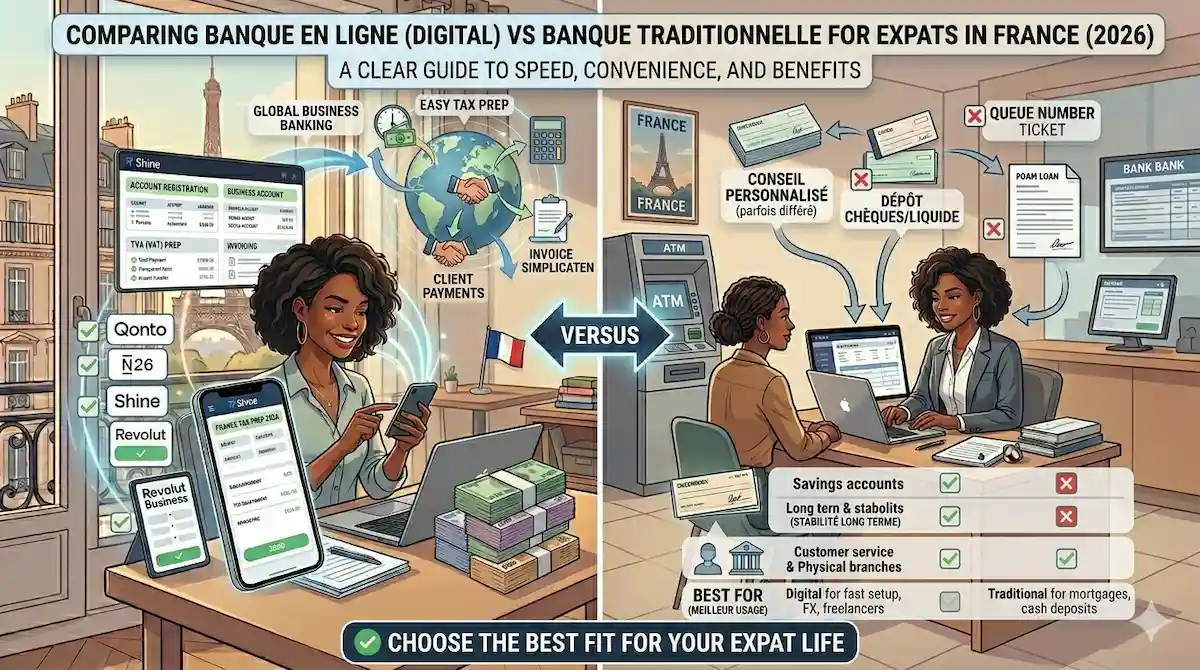
Because of this, many expats eventually adopt a hybrid banking strategy:
- A digital bank for quick setup and everyday spending
- A traditional bank for long-term financial stability
Best Bank for Expats in France: The French Banking Paradox
When settling in, selecting the best bank for expats in France can save time and reduce stress.
Moving to France is exciting. The culture, lifestyle, and career opportunities attract thousands of international residents every year.
Yet one practical issue often surprises newcomers: opening a bank account can be unexpectedly complicated.
Many landlords require a French bank account to pay rent. But banks often ask for a proof of address (justificatif de domicile) before opening an account. If you haven’t rented an apartment yet, that proof may not exist.
This circular requirement is commonly called the “French banking paradox.”
Fortunately, by 2026 the banking landscape has become more newcomer-friendly. Digital banks now allow people to open accounts quickly and receive a French IBAN without extensive paperwork. This makes it easier for expats settling in cities like Paris, Lyon, or Bordeaux to start their financial life smoothly.
Having a bank account in France is essential for:
- Receiving your salary
- Paying rent and utility bills
- Managing subscriptions and insurance
- Sending or receiving international transfers
A Smart Strategy: Using Two Banks
Many expats discover that relying on a single bank does not cover all their needs.
Understanding which is the best bank for expats in France helps you decide between a digital bank and a traditional bank.
A two-bank strategy can provide both convenience and long-term financial stability.
Digital Bank: Fast and Flexible
Digital banks are ideal when you first arrive.
They typically offer:
- Quick online account opening
- English-language apps
- Instant card payments
- Low-cost international transfers
- Budgeting tools inside the app
This allows newcomers to start paying rent or receiving money almost immediately.
Traditional Bank: Long-Term Financial Stability
Once you settle in France and have a permanent address, traditional banks become valuable.
They provide services such as:
- Mortgages and personal loans
- Long-term savings accounts
- Investment products
- Government-regulated savings accounts like Livret A
Traditional banks also help build financial credibility within the French system, which can be useful when applying for housing loans or other financial products.
Best Bank for Expats in France – Digital Banking Options
For those looking for speed and convenience, choosing the best bank for expats in France often starts with a digital account.
Digital banking is often the easiest entry point for newcomers.
Revolut – Fast Setup for New Arrivals
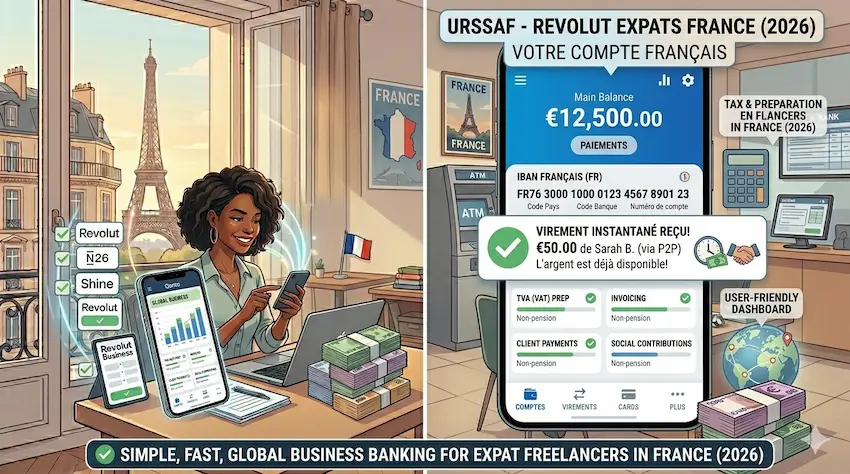
Revolut has become one of the most popular financial apps among expats across Europe.
Many users appreciate that they can open an account in minutes and receive a French IBAN, which simplifies everyday payments in France.
Advantages
- Account opening usually takes only minutes
- French IBAN available for local payments
- Multi-currency accounts
- Excellent mobile app with budgeting tools
Limitations
- Free plans include some usage limits
- Currency exchange on weekends may include additional fees
Verdict:
A strong first bank for newcomers who want to start banking immediately after arriving in France.
N26 – Simple and Transparent Mobile Banking
Another well-known digital bank in Europe is N26.
The platform focuses on simplicity, transparent pricing, and mobile-first banking.
Advantages
- Clean and easy-to-use mobile app
- Transparent fee structure
- Useful spending analytics
- Good for travel across Europe
Limitations
- Some accounts still provide a German IBAN (DE)
- Certain French services prefer FR IBANs
Verdict:
A solid secondary account for daily spending or frequent travelers.
Wise – Ideal for International Transfers
For freelancers, remote workers, or expats sending money abroad, Wise can be extremely useful.
Wise specializes in cross-border transfers with transparent exchange rates.
Advantages
- Competitive exchange rates
- Multi-currency accounts
- Transparent transfer fees
Limitations
- Not a full traditional bank
- Limited savings or lending services
Verdict:
Best for international money transfers and multi-currency management.
Best Bank for Expats in France – Traditional Banking Options
For long-term stability, knowing the best bank for expats in France ensures access to savings, loans, and investment products.
Once you are settled, traditional banks offer more complete financial services.
BNP Paribas and Hello bank!

BNP Paribas is one of the largest banks in Europe. Its digital branch Hello bank! combines online convenience with access to physical branches.
Advantages
- Strong financial stability
- Large branch network across France
- Access to loans, mortgages, and savings accounts
Limitations
- Account opening usually requires a full dossier
- Administrative processes may be slower
Verdict:
A reliable option for expats planning to live in France long-term.
BoursoBank (formerly Boursorama Banque) – Low Fees and Strong Online Banking
BoursoBank is frequently ranked among the lowest-fee banks in France.
Advantages
- Very low banking fees
- Excellent mobile and online interface
- Access to savings accounts including Livret A
Limitations
- Interface primarily in French
- Customer service mostly French-speaking
Verdict:
A strong option for expats comfortable using French banking services.
The “Justificatif de Domicile” Challenge
One of the biggest hurdles when opening a bank account in France is providing proof of address.
Commonly accepted documents include:
- Electricity bill
- Internet bill
- Rental contract
If you are staying temporarily with someone, you can often provide an attestation d’hébergement. This usually includes:
- A signed statement from the host
- A copy of the host’s ID
- A recent utility bill in their name
Digital banks are often more flexible with these documents.
According to Banque de France, every resident has a legal right to a bank account under the “droit au compte” rule if traditional banks refuse an application.
Common Banking Mistakes Expats Should Avoid
Closing Your Old Bank Too Early
Keep your previous bank account open for several months after moving.
This helps manage:
- International payments
- Tax refunds
- Subscription renewals
Accepting Optional Insurance Without Checking
Some banks offer additional insurance products, such as protection for lost cards or personal belongings.
Always read the terms carefully before accepting these add-ons.
Forgetting to Save Your RIB
A Relevé d’Identité Bancaire (RIB) contains your bank details and is required for many everyday payments in France.
You will need it for:
- Salary payments
- Rent transfers
- Utility bills
- Subscriptions
Keeping a digital copy on your phone can save time later.
Step-by-Step: Opening a Digital Bank Account
Opening a digital account is usually straightforward.
Typical steps include:
- Download the banking app
- Verify your passport or ID
- Take a selfie for identity verification
- Add your French address
- Receive your IBAN and activate your card
Many expats start with a digital bank and later add a traditional bank once they have a stable address.
Frequently Asked Questions
Which is the best bank for expats in France for new arrivals?
For new arrivals in France, the best bank for expats is often a digital bank like Revolut or N26. These banks allow you to open an account quickly, get a French IBAN, and start paying rent, utilities, and subscriptions immediately. Once you have a permanent address, you can add a traditional bank like BNP Paribas or BoursoBank for long-term financial stability and access to savings accounts, loans, and mortgages.
Can foreigners open a bank account in France?
Yes. In most cases, a passport and proof of address are sufficient. Digital banks often simplify the process further.
Do I need a French IBAN?
Technically, all SEPA IBANs should work within the European Union. However, some French companies still prefer or require an FR IBAN for automated payments.
What is Livret A?
A Livret A is a government-regulated savings account available through most French banks.
It offers:
- Tax-free interest
- Government-regulated rates
- Deposit protection
Official information:
https://www.service-public.fr
Final Thoughts
Opening a bank account in France may feel complicated at first, but the process has become significantly easier in recent years.
For most newcomers, the simplest approach is to start with a digital bank for quick access to a French IBAN and everyday payments.
Later, adding a traditional bank can help unlock savings products, loans, and long-term financial services. This approach helps newcomers choose the best bank for expats in France.
With the right strategy, managing your finances in France can quickly become smooth and stress-free.
Disclaimer: This article is for informational purposes only and does not constitute financial advice. Banking regulations, interest rates, and services may change over time. Always verify details directly on official bank or government websites before opening an account.